MAN IN THE MIDDLE by Robert Storr
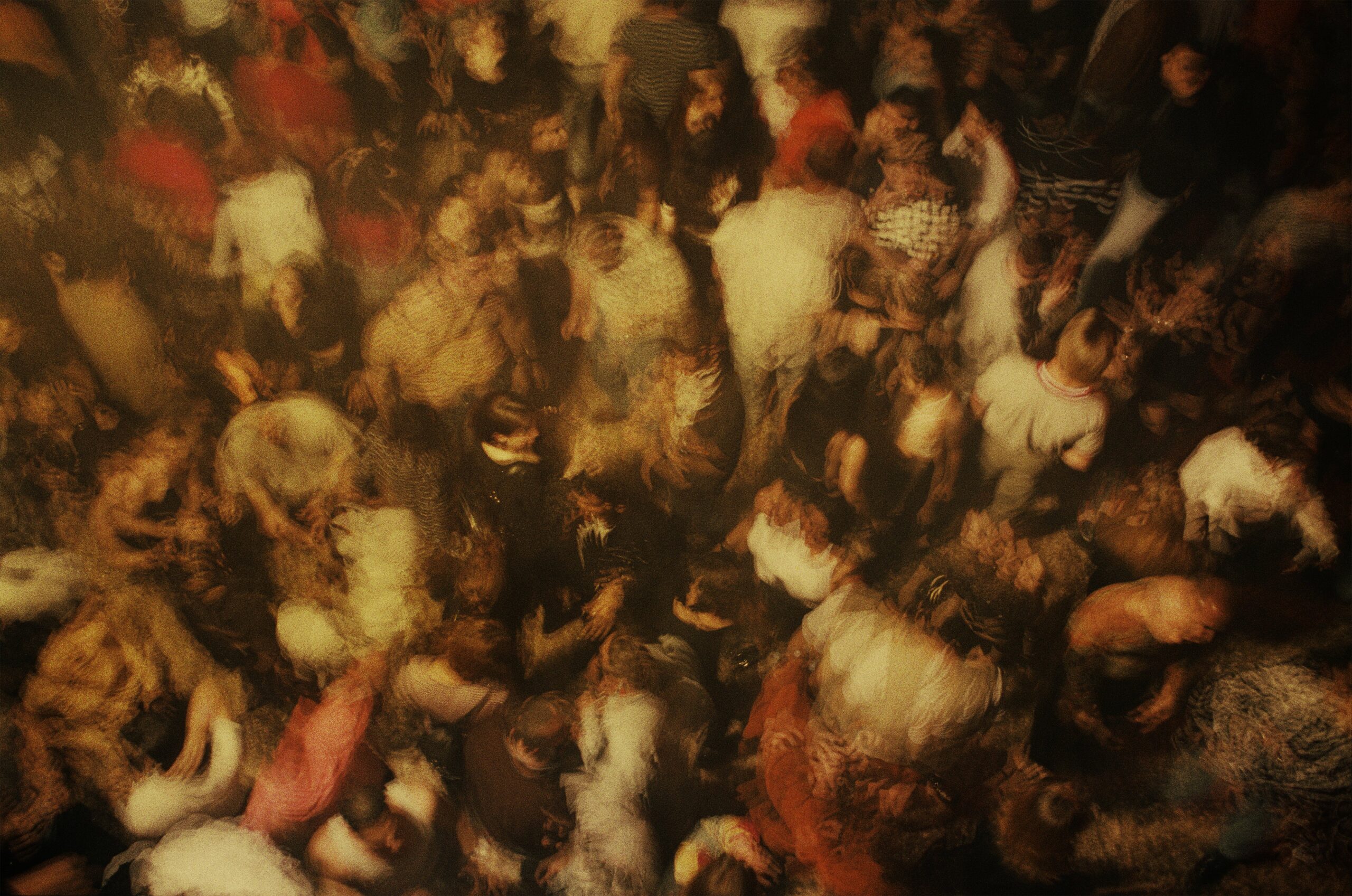
The great modern subject is people in number; the community, the crowd, the multitude, the masses. Of these four categories of “the many” Tomer Ganihar photographs the first three in order of magnitude and by nature of affinity.The last category is alien to him given that it is predicated on regimented if not involuntary association and presages the nightmare of metastatic hysteria and brutality. Sometimes he observes them as an almost- but never quite- undifferentiated organism. Other times he zeros in on one or two members of the group, and is acutely attentive to how their expressions, their postures or their actions distinguish them, even as those actions speed past the camera’s ability to freeze them and so engenders a blur, or- this latter
effect being the common denominator of Ganihar’s pictures -causing light to flare and splinter like a blizzard of small explosions, like a hail of fireworks with no unifying pattern, as if light itself was simultaneously swarming and scattering, as if light itself was a community, a crowd, a multitude- but never just as mass – of vital sparks.Pan, focus, dissolve; the visual variables are cinematic as much as they are
photographic.This is unsurprising given that Ganihar is also a filmmaker, and necessary given that the targets of his lens are usually kinetic.The most kinetic are the gatherings of young people he documents from their midst as a participant-observer. Rather, “celebrant” might be the better term, since the spontaneous coming together of which he is a part is prompted by a shared desire for both for belonging and transcendence.
An offshoot of earlier generations of youth culture from Woodstock Nation on down but now thoroughly international and the very antithesis of the industrialized Rock Spectacle that is Woodstock’s commercial mutation these improvised assemblies contribute a new category and a new collective noun to the list above; rave. But if the goal of the rave is ecstasy, the paths to it vary as widely as the individuals who converge in order to find it. Thus an Orthodox Jew in his twenties exalts among contemporaries whose attire does not declare their beliefs and who may in fact have no codified faith of any kind yet join with him in the delirious loss of self that is and has been the aspiration of virtually every form of mysticism in every part if the world in every age.
Meanwhile Ganihar knows that solitary men and women also strive for selflessness- in a mosque as well as a synagogue or a church or on Holy ground by the edge of the Ganges.That Ganihar comes from a region convulsed by the conflict of creeds makes him hypersensitive to what brings people together voluntarily. And it helps him to see the absurdity of what separates them despite the reality that they are neighbors.Thus he notices that the Muslim man praying alone does so in a mosque that is cheek by jowl with a store that sells Jewish artifacts.And it is same eye for ironies which unite rather than divide that catches the way tourists of disparate types mingle and make contact on sight-seeing trips where among the sites to be seen are each other and the motley array they circumstantially form. In the mid-nineteenth century the sardonic poet and critic Charles Baudelaire – who, incidentally, hated photography- imagined the quintessential modern man as a neurasthenic but preternaturally alert wanderer in the city- a “flaneur.” Ganihar is a descendant of that dandified creature but he has the energy of his generation and the means. He is generous with both as well as generous of spirit in harsh disheartening times.